
What Makes Artisan Clothing Worth the Price
Last Updated: November 12, 2026
Quick Summary
Artisan clothing is worth the price when skilled hand-making, small production runs and quality materials show up in the garment itself. Price gaps come mostly from labor and small-batch overhead rather than fabric, so check the maker, the run size and the techniques before you buy.
- Check for a named maker, a small production run and specific techniques used.
- In one illustrative comparison, labor is 35% of an artisan shirt's cost versus 20% for a mass-market shirt.
- Cost per wear depends on realistic wear counts, so estimate your own wear before deciding.
- Inspect seams, fabric weight, finishing and print application before buying.
- Ask about returns and care instructions, especially for custom or made-to-order pieces.
Table of Contents
- What Artisan-Made Clothing Actually Means
- Artisan-Made vs. Factory-Made Clothing: Where the Difference Shows
- Breaking Down the Price: Labor, Materials and Small-Batch Production
- Cost Per Wear: Does a Higher Price Mean Lower Long-Term Cost?
- How to Identify Quality Clothing Before You Buy
- Art Print Clothing: Original Design as Part of the Value
- When Artisan Clothing Is Not Worth the Price, and How to Buy Well
- Choosing Your First Piece From OG Custom Threads
- Frequently Asked Questions
What Artisan-Made Clothing Actually Means
Artisan clothing is the kind of garment made by hand or in very small runs, usually by people who have trained in cutting, sewing and finishing rather than by a production line. A label that says "handcrafted" tells you little on its own. What matters is who made the garment, how many were made, and how much skilled work went into it.
Researchers studying designer and artisan collaborations describe value as something created through practices like craft, making and close contact between maker and buyer, rather than something stamped on by a brand. A 2024 systematic analysis of designer-artisan collaborations in sustainable fashion (Hu and coauthors, value-creating practices in designer-artisan collaboration) found that these partnerships depend on shared making practices, not just a shared story.
Use that as a practical test. When a seller says a piece is artisan-made, look for a named maker, a small production run, and specifics about the techniques used.
Artisan-Made vs. Factory-Made Clothing: Where the Difference Shows
The difference between artisan and factory-made clothing shows up in the details. Factory garments are built for speed and consistency across thousands of units. Artisan pieces are built around the maker's hands and a limited run, which changes how seams are finished, how patterns are fitted and how art or print is applied. You can see a heavyweight example in the Malcolm X Unisex Heavy Blend Hooded Og Sweatshirt.
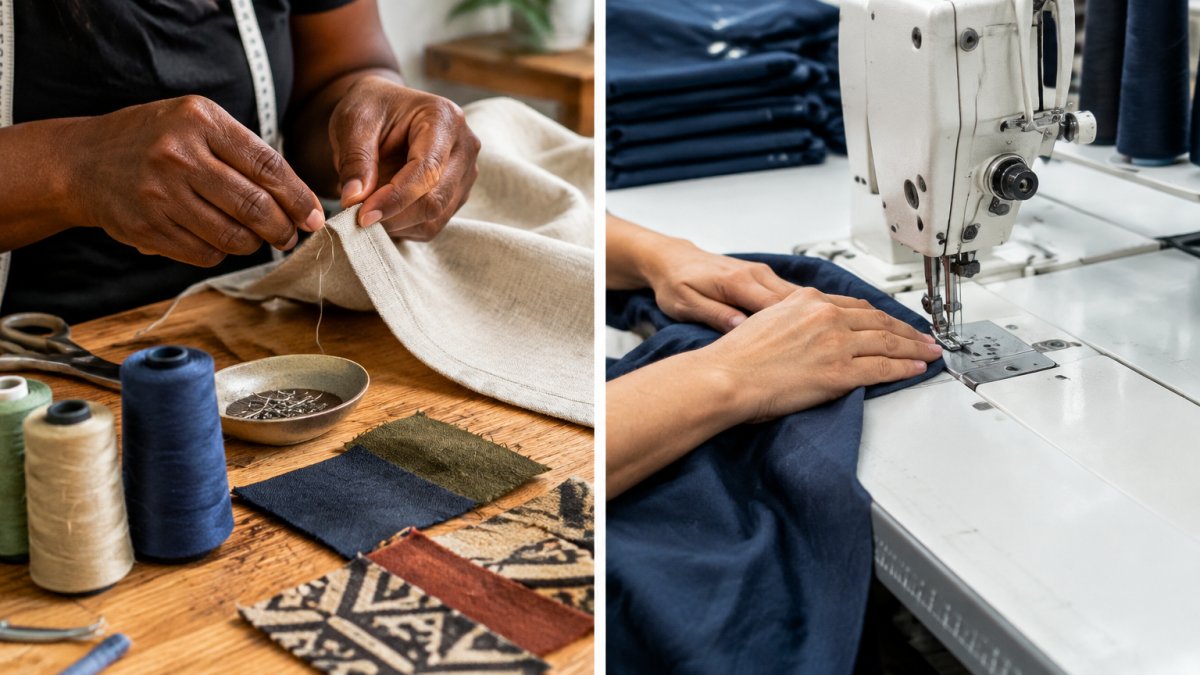
A useful case study comes from a makershop at a fab lab in Bolzano, Italy, where people made clothing together as a shared practice. Researchers writing about that work (Mazzarella and coauthors, socialising value creation through making clothing) described how making garments in this way builds value through the process itself, not only the finished item.
Factory-made clothing is not automatically worse. It is often more affordable and more consistent in size. The question is which trade-off suits your needs.
Breaking Down the Price: Labor, Materials and Small-Batch Production
Artisan prices are driven by three main costs: skilled labor, material quality and small-batch production. Skilled labor takes time, and time costs money. Small runs cannot spread fixed costs across thousands of units the way a factory can.
Industry commentary on artisan apparel makes the same point, identifying skilled labor, quality materials and small-batch production as the main cost drivers (Lotus Temple, why artisan clothing costs more). That source does not quantify each cost, so most articles stop there. A clearer way to see the premium is to build a labeled example and show where each dollar goes.
Take a hypothetical $120 artisan shirt and a $30 mass-market shirt of similar style. The numbers below are illustrative, not a quote for any specific garment, but the proportions reflect how small-run production typically stacks up against factory production.
| Cost line | Artisan shirt ($120) | Mass-market shirt ($30) |
|---|---|---|
| Fabric and trim | $24 (20%) | $6 (20%) |
| Cutting, sewing and finishing labor | $42 (35%) | $6 (20%) |
| Pattern development, sampling and design | $12 (10%) | $1.50 (5%) |
| Small-batch production overhead | $18 (15%) | $3 (10%) |
| Shipping and fulfillment | $6 (5%) | $3 (10%) |
| Retail margin | $18 (15%) | $10.50 (35%) |
Read the table by line rather than by total. Fabric is often a similar share of both prices, which is why material alone rarely explains the gap. The bigger differences sit in labor and in how fixed costs are absorbed. A factory spreads pattern-making, sampling and machine setup across thousands of units, so each shirt carries pennies of that work. A small run spreads the same setup across far fewer units, and the per-piece share rises.
The retail line is where the two columns flip. Mass-market shirts often carry a higher retail margin percentage because the brand, distributor and store each take a cut of a low unit price. Artisan sellers frequently sell direct, which trims the number of hands between maker and buyer but does not eliminate the cost of photography, packaging, customer service and returns.
Watch out: a seller who shows a cost breakdown but leaves out returns, payment processing fees or the cost of unsold inventory is giving you a partial picture, because those costs are real and have to be recovered somewhere in the price.
Pricing depends on the item, the quantity and any custom work. For current prices, check the OG Custom Threads LLC website or request a quote.
Cost Per Wear: Does a Higher Price Mean Lower Long-Term Cost?
Cost per wear is the purchase price divided by the number of times you wear a garment. A higher price can still mean a lower cost per wear if the piece lasts longer and gets worn more often. But this is an assumption, not a guarantee, so the useful move is to run the math with your own numbers instead of trusting a slogan.
Here is a worked comparison using two hypothetical shirts. The wear counts are estimates you should replace with your own habits.
| Artisan shirt | Mass-market shirt | |
|---|---|---|
| Purchase price | $120 | $30 |
| Estimated wears before replacement | 150 | 40 |
| Cost per wear | $0.80 | $0.75 |
In this example the artisan shirt is close to the cheaper shirt on cost per wear, not dramatically better. Change the assumptions and the answer changes. If the artisan shirt lasts 200 wears, cost per wear falls to $0.60. If you only wear it 60 times because the fit or style does not suit your routine, cost per wear rises to $2.00 and the cheaper shirt wins. That sensitivity is the honest lesson: cost per wear is a tool for testing your own expectations, not a proof that expensive clothing pays for itself.
Three variables drive the result, and each is worth checking before you buy.
- Realistic wear count. Count how often you reach for similar pieces you already own. A garment that fits your weekly routine gets worn far more than an occasion piece.
- Expected lifespan. Longevity depends on fabric, construction and care. A heavier cotton or wool blend with reinforced seams usually outlasts a thin knit, but only if you wash and store it properly.
- Repair and resale. A piece that can be rehemmed, patched or rebuttoned stays in rotation longer. Resale value also lowers net cost: if you later sell a well-made garment for a portion of what you paid, subtract that from the price before dividing.
Watch out: comparing cost per wear across garments of different categories, such as a jacket against a T-shirt, produces a misleading number because expected wear counts are not comparable.
To run the math yourself, estimate how many times you will realistically wear a piece, divide the price by that number, and compare the result with a cheaper alternative you would actually replace. Then repeat the calculation with a lower wear count to see how much your decision depends on that estimate.
How to Identify Quality Clothing Before You Buy
Quality is easier to judge with a checklist than with a sales page. Look at these points before you buy:
- Seams: Check that stitching is even, tight and not puckered.
- Fabric weight: Heavier fabric usually resists wear better, though it is not always warmer or better fitting.
- Finishing: Look at hems, cuffs and collar edges for neat, finished edges.
- Print or art application: Check whether the design sits cleanly and is not cracking.
- Maker information: A seller who names the designer or artist is easier to trust.
These are signs to look for, not proof of quality on their own. Ask the seller for close-up photos and care instructions if they are not listed.
Art Print Clothing: Original Design as Part of the Value
Art print clothing carries a design that someone created as an original work. For buyers who want personal storytelling in what they wear, original art adds a layer of value that a generic graphic does not.
OG Custom Threads LLC features original artwork, including designs by Lola Buckwald. Choosing an original design means you are buying into the artist's work, not just a repeated stock graphic.
When Artisan Clothing Is Not Worth the Price, and How to Buy Well
Artisan clothing is not always the right choice. It may not be worth the price if you buy mainly for trends that change quickly, if you need a piece for a short-term occasion, or if the price is driven mostly by branding rather than by visible craft.
To buy well, set a budget, decide how often you will wear the piece, check the care instructions and compare the item with an alternative you would otherwise buy. Ask about return policies before you order, especially for custom or made-to-order work.
Choosing Your First Piece From OG Custom Threads
If you are new to our collection, start with one piece you will wear often, rather than buying several at once. Look at the design, fabric and how it fits your daily routine. For an affordable first item, consider the Og Custom Threads Car Magnet.
Shop the full collection at OG Custom Threads LLC to find the piece that fits your style and budget.
Frequently Asked Questions
Why does artisan clothing cost more than mass-produced clothing?
Artisan clothing costs more mainly because of skilled labor, higher-quality materials and small-batch production. A garment cut and sewn by a trained maker takes more hours than one run through a high-volume factory line, and small runs cannot spread fixed costs across thousands of units the way mass producers can. Pricing also depends on quantity, design complexity and materials, so the exact cost varies by piece. For current prices on any OG Custom Threads item, check the product page on the brand's website or request a quote.
How can you tell if clothing is genuinely artisan-made?
Look for specific, verifiable details rather than the word artisan alone. Ask who made the garment, where and how, and whether the designs are original. Check construction details such as finished seams, reinforced stress points, even stitching and how the pattern matches at seams. Brands that stand behind their work will usually name their designers and explain their process. Be cautious of claims that cannot be checked or that come with no information about the maker.
Is handmade clothing worth the extra cost?
It can be, depending on how often you wear the piece and how long it lasts. Cost per wear is the simplest test: divide the purchase price by the number of times you expect to wear the item. A higher-priced garment worn often for years can cost less per wear than a cheap one replaced after a season. That math only holds if the piece actually lasts, so check construction and materials before assuming it will. A higher price alone does not prove better value.
What should you check before buying art print clothing?
Confirm that the artwork is original and that you know who created it. Ask whether the artist is credited and whether the design was licensed or made in-house. Review the print method and fabric, since a well-printed design on sturdy cotton will hold up better through repeated washing than a thin, low-quality print. Read the care instructions and the return policy, and check the brand's website for current pricing and shipping timelines before you order.
